
The global tungsten market has entered another important phase in September 2026. While some parts of the supply chain have seen price corrections from earlier highs, supply availability, regional price differences, and limited spot liquidity remain important concerns for industrial buyers.
For tungsten carbide and cemented carbide manufacturers, these changes can affect raw material costs, production planning, and purchasing decisions.
Recent market analysis shows that the tungsten supply chain is facing several interconnected challenges, particularly around APT availability and the difference between domestic Chinese and international markets.
For carbide buyers, the key question is no longer simply “What is the current tungsten price?”
It is also:
How stable is the supply, and what does the changing market mean for future procurement?
Recent Developments in the Tungsten Market
Tungsten prices experienced significant volatility during 2026.
Earlier in the year, tightening supply and export restrictions contributed to a sharp increase in tungsten prices. More recently, some segments of the market have experienced corrections and weaker downstream trading activity.
However, a price correction does not necessarily mean that supply concerns have disappeared.
The latest SMM analysis in early September highlighted a number of challenges across the global tungsten market, including limited APT smelting capacity, scarce spot liquidity, and a widening difference between domestic Chinese and overseas prices.
This means that buyers need to look beyond a single market quotation when evaluating tungsten-related procurement.
Regional Tungsten Markets Are Becoming More Divergent
One of the important developments in 2026 has been the increasing divergence between domestic Chinese and international tungsten markets.
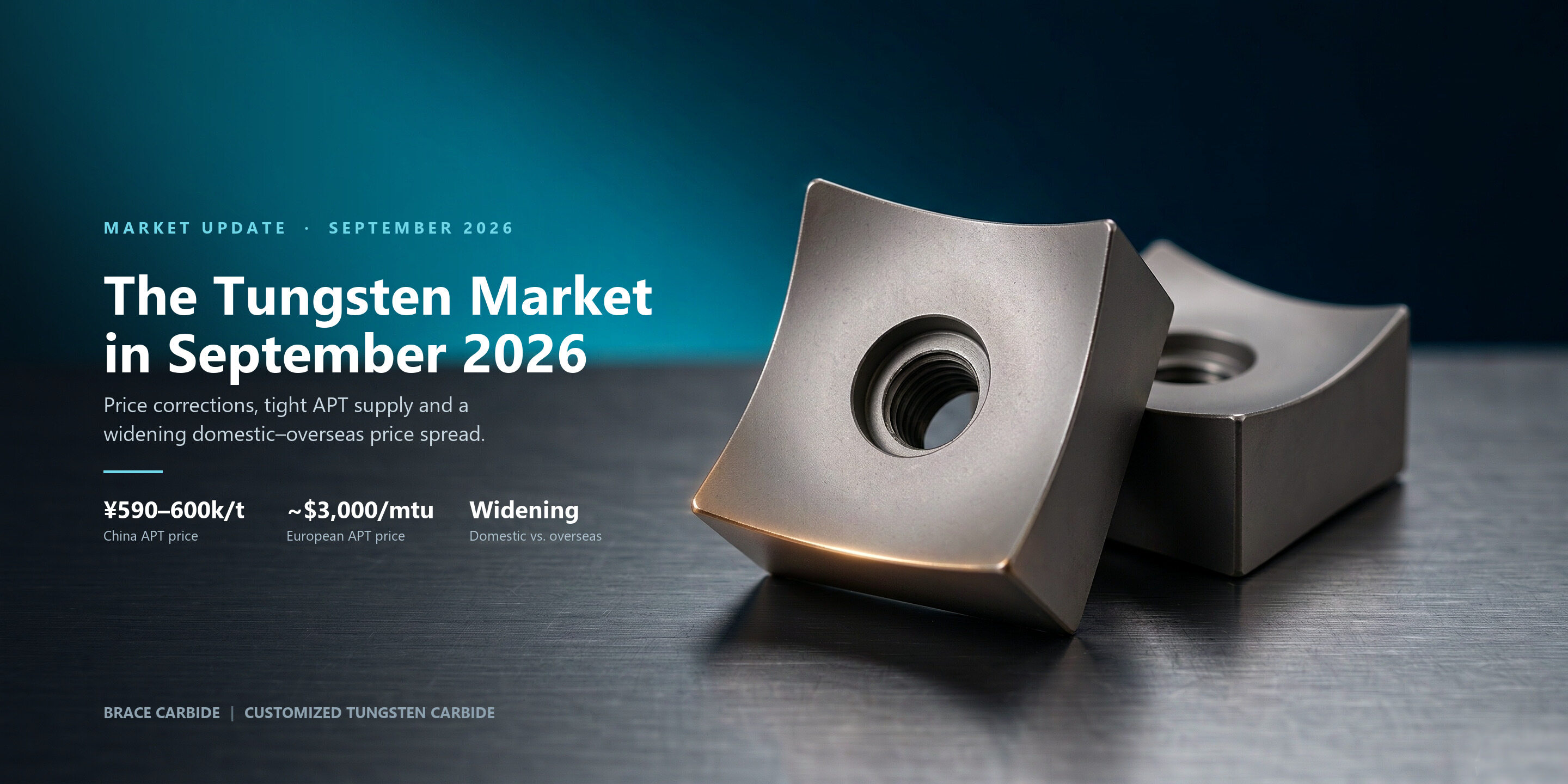
Recent market data showed Chinese APT prices around RMB 590,000–600,000 per metric ton in early September, while European APT prices remained close to $3,000/mtu. SMM also noted a significant widening of the domestic-overseas price spread.
This regional divergence can create additional challenges for international carbide manufacturers and buyers.
Different markets may face different:
Raw material costs
Supply availability
Import and export conditions
Inventory levels
Procurement cycles
As a result, international buyers should avoid evaluating tungsten costs based only on one regional price indicator.
Supply Availability Remains an Important Procurement Factor
For carbide manufacturers, the availability of tungsten raw materials can be just as important as the quoted price.
Tungsten carbide production depends on a stable supply of tungsten-based raw materials. If raw material availability becomes less predictable, manufacturers may need to adjust purchasing schedules and inventory planning.
The latest market analysis points to limited APT smelting capacity and relatively scarce spot liquidity as important constraints in the current market.
For industrial buyers, this reinforces the importance of working with suppliers who can manage raw material procurement and production planning effectively.
What Does This Mean for Tungsten Carbide Buyers?
Changing tungsten market conditions can influence purchasing decisions in several ways.
1. Price Should Not Be the Only Procurement Indicator
A lower quotation may appear attractive, but buyers should also consider whether the supplier can maintain consistent material quality and production schedules.
For tungsten carbide components, the cost of the finished product is influenced by raw materials, carbide grade, product dimensions, processing requirements, and production volume.
Therefore, comparing suppliers only by unit price may not provide a complete picture.
2. Supply Stability Is Becoming More Important
When raw material markets are volatile, supply stability becomes an increasingly important consideration.
Industrial buyers may need to evaluate:
Supplier production capacity
Raw material sourcing
Lead time
Inventory planning
Production consistency
Ability to handle repeat orders
A reliable supply arrangement can help reduce uncertainty for manufacturers using carbide components on a regular basis.
3. Carbide Grade Selection Can Affect Overall Cost
Not every application requires the same tungsten carbide grade.
Different operating conditions may require different balances between:
Hardness
Wear resistance
Toughness
Impact resistance
Selecting an appropriate carbide grade can help avoid both under-specification and unnecessary material costs.
For industrial wear components, the objective should be to find a suitable balance between performance and cost rather than simply selecting the highest hardness available.
4. Customized Products Can Help Optimize Material Use
Market conditions also make product design and customization more important.
Standard products may not always match the dimensions or operating requirements of a specific machine.
Customized carbide components can be manufactured according to:
Customer drawings
Dimensions
Application requirements
Material specifications
Performance requirements
Properly designed components can help manufacturers use carbide material more efficiently while meeting the required performance targets.
Which Carbide Products Are Most Relevant to Industrial Buyers?
The impact of tungsten market conditions can extend across many carbide applications.
Tungsten Carbide Wear Parts
Industrial wear parts are exposed to continuous abrasion, impact, and material contact.
Selecting a suitable carbide grade and component design is important for achieving reliable service life.
You can learn more about our Tungsten Carbide Wear Parts.
Industrial Shredder Blades
Shredder blades are used in recycling and waste-processing applications where cutting performance and wear resistance are important.
Different materials and operating conditions may require different blade designs and material combinations.
See our Industrial Shredder Blades for more information.
Customized Carbide Components
OEM customers may require carbide components with specific dimensions, grades, geometries, or technical requirements.
Customized production allows manufacturers to develop components according to actual application conditions.
For customized requirements, contact Brace Carbide with your drawings or specifications.
Procurement Trends to Watch in Different Markets
Although specific purchasing volumes can vary by customer and application, several broad procurement considerations are becoming increasingly relevant.
European Buyers
European buyers continue to face higher international tungsten costs and supply-chain uncertainty. Regional price differences make supplier selection and long-term procurement planning particularly important.
Asian Buyers
Asian markets remain closely connected to the Chinese tungsten supply chain, while domestic market conditions can differ significantly from international prices.
For buyers sourcing carbide components from Asia, understanding the supplier's raw material and production situation can be useful when evaluating quotations.
North American Buyers
For North American industrial buyers, supply diversification and predictable sourcing are becoming increasingly relevant as global tungsten markets remain sensitive to trade and supply developments.
Recycling and Wear-Intensive Industries
Industries that rely heavily on wear-resistant components may pay increasing attention to product life, replacement frequency, and material efficiency.
For these buyers, the total cost of using a carbide component can be more important than its initial purchase price.
How Should Carbide Buyers Respond?
The current tungsten market does not necessarily mean that buyers should simply purchase more material.
A more practical approach is to improve procurement planning.
Industrial buyers can consider:
1. Monitoring raw material trends
Keep track of tungsten concentrate, APT, tungsten powder, and carbide market developments.
2. Evaluating suppliers beyond price
Consider quality consistency, production stability, communication, lead time, and customization capability.
3. Reviewing carbide grades
Make sure the selected grade matches the actual operating environment.
4. Planning repeat orders earlier
For products with predictable consumption, better purchasing planning can help reduce supply uncertainty.
5. Considering customized solutions
Customized dimensions and material combinations may help optimize product performance and material usage.
How Brace Carbide Supports Industrial Carbide Buyers
At Brace Carbide, we focus on customized tungsten carbide and cemented carbide solutions for industrial applications.
Our product range includes:
Tungsten carbide wear parts
Industrial shredder blades
Carbide cutting components
Customized carbide components
OEM and ODM products
We can work according to customer drawings, dimensions, material requirements, and application conditions.
For industrial buyers, our focus is not simply on supplying a carbide component. We aim to understand the application and provide a solution suitable for the customer's actual requirements.
To discuss a customized carbide project, contact Brace Carbide with your drawings or specifications.
What Should Carbide Buyers Watch Next?
The tungsten market is likely to remain an important procurement consideration for carbide manufacturers and industrial buyers.
The most important factors to watch include:
APT supply availability
Regional price differences
Tungsten raw material costs
International trade conditions
Downstream carbide demand
Supplier inventory and production planning
Recycling and secondary tungsten supply
The market may continue to move in different directions across regions and stages of the supply chain.
For carbide buyers, this makes procurement planning, supplier evaluation, and material selection increasingly important.
Conclusion
The tungsten market in September 2026 is characterized by a combination of price adjustments, supply constraints, and increasing regional divergence.
For tungsten carbide buyers, the key lesson is that procurement decisions should not be based on price alone.
Supply stability, carbide grade, product design, service life, supplier reliability, and customization capability can all influence the long-term value of a carbide component.
As the global tungsten market continues to evolve, buyers who pay attention to both raw material trends and application requirements will be better positioned to make informed purchasing decisions.
At Brace Carbide, we continue to provide customized tungsten carbide and cemented carbide solutions for industrial customers worldwide.
FAQ
What is happening in the tungsten market in September 2026?
The market remains volatile, with regional price differences, limited APT spot liquidity, and supply-chain constraints continuing to influence procurement decisions.
Why are tungsten prices important for carbide buyers?
Tungsten is a key raw material for cemented carbide products. Changes in raw material costs can affect the cost of carbide powders, components, and finished products.
Should buyers focus only on tungsten prices?
No. Buyers should also consider supply stability, carbide grade, product design, supplier reliability, lead time, and total operating costs.
How can customized carbide components help buyers?
Customized components can be designed around specific dimensions, materials, and operating conditions, potentially improving material efficiency and service life.
Can Brace Carbide manufacture customized carbide products?
Yes. Brace Carbide provides customized tungsten carbide and cemented carbide components based on customer drawings, specifications, and application requirements.