
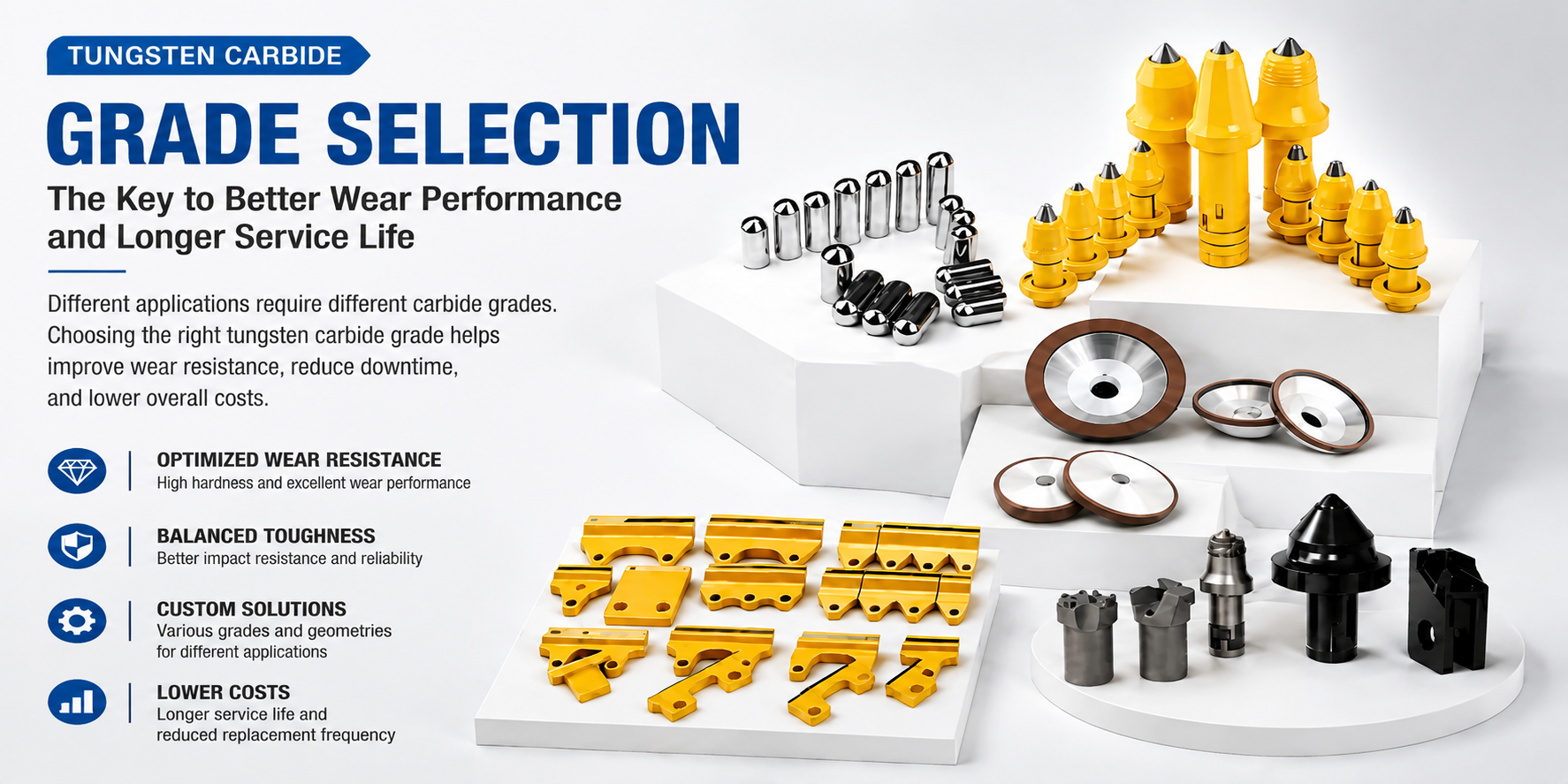
Understanding Tungsten Carbide Grades
Tungsten carbide is a composite material mainly consisting of tungsten carbide particles combined with a metallic binder, commonly cobalt.
The performance of cemented carbide depends on several factors, including:
Tungsten carbide grain size
Binder content
Material composition
Manufacturing process
Different combinations of these factors create different carbide grades with specific performance characteristics.
Generally, carbide grades can be balanced toward:
Higher hardness and wear resistance
Higher toughness and impact resistance
Choosing the right balance is essential because improving one property may affect another.
For example, a grade with extremely high hardness may provide excellent abrasion resistance but may not be suitable for applications involving heavy impact.
Hardness vs Toughness: Finding the Right Balance
One of the most important considerations when selecting tungsten carbide is the balance between hardness and toughness.
High Hardness Carbide Grades
Carbide grades with higher hardness are often selected for applications involving severe abrasion.
Typical applications include:
Wear plates
Cutting components
Abrasive material processing
High-wear industrial parts
These grades provide excellent resistance against material loss caused by continuous friction.
High Toughness Carbide Grades
Applications involving impact or shock loading require carbide materials with higher toughness.
Typical examples include:
Mining components
Crushing applications
Heavy-duty wear parts
Higher toughness helps reduce the risk of cracking or chipping under strong impact conditions.
Factors That Influence Tungsten Carbide Grade Selection
1. Working Environment
The operating environment is one of the first factors to consider.
Important conditions include:
Material being processed
Operating temperature
Contact pressure
Exposure to abrasion
Impact frequency
A carbide grade suitable for one application may not perform well in another environment.
2. Wear Mechanism
Understanding how the component wears is also important.
Different applications may experience:
Abrasive wear
Impact wear
Adhesive wear
Erosion wear
Identifying the main wear mechanism helps determine a more suitable carbide solution.
3. Equipment Operating Conditions
The performance requirements of the equipment also influence material selection.
Factors include:
Operating speed
Load conditions
Machine design
Expected service interval
For example, a high-speed cutting application may require different carbide characteristics compared with a heavy-impact crushing application.
Why Correct Carbide Grade Selection Reduces Long-Term Costs
Choosing the correct tungsten carbide grade can provide benefits beyond initial product performance.
A suitable carbide solution may help:
Extend component service life
Reduce replacement frequency
Improve equipment availability
Lower maintenance costs
Although material selection may appear to be a small part of procurement, it can have a significant impact on long-term operating efficiency.
This is why many industrial buyers work closely with experienced carbide manufacturers when developing customized solutions.
Custom Tungsten Carbide Solutions for Different Applications
Industrial applications often require more than standard carbide products.
Different customers may have different requirements regarding:
Dimensions
Material grades
Surface finishing
Mechanical performance
Application conditions
At Brace Carbide, we provide customized tungsten carbide solutions based on customer requirements and working conditions.
Our capabilities include:
Tungsten carbide wear parts
Industrial shredder blades
Customized carbide components
OEM and ODM manufacturing
Precision machining and grinding
By understanding the application environment, we help customers select suitable carbide solutions designed for reliable performance.
Why Choose Brace Carbide for Tungsten Carbide Components?
Brace Carbide focuses on providing customized cemented carbide solutions for global industrial customers.
We understand that every application has different performance requirements.
Through professional communication and manufacturing experience, we support customers with:
Suitable material recommendations
Customized product design
Stable production capability
Reliable product quality
Whether for wear-resistant components, industrial blades, or customized carbide parts, our goal is to help customers achieve better performance and longer service life.
Conclusion
Selecting the correct tungsten carbide grade is a key factor in achieving reliable wear performance.
The best carbide solution is not always the hardest material, but the one that provides the right balance between hardness, toughness, and application requirements.
By understanding operating conditions and choosing suitable carbide materials, industrial buyers can improve equipment reliability and reduce long-term costs.
At Brace Carbide, we continue to provide customized tungsten carbide solutions designed to meet the challenges of different industrial applications.
FAQ
What is the importance of tungsten carbide grade selection?
Tungsten carbide grade selection determines the balance between hardness, toughness, and wear resistance, which directly affects component performance and service life.
Is harder tungsten carbide always better?
No. Higher hardness provides better abrasion resistance, but some applications require higher toughness to withstand impact and shock loads.
How do I choose the right tungsten carbide grade?
The right grade depends on factors such as working environment, wear mechanism, impact conditions, operating speed, and expected service life.
Can tungsten carbide components be customized?
Yes. Tungsten carbide components can be customized according to application requirements, drawings, dimensions, and performance needs.
What industries use tungsten carbide wear parts?
Tungsten carbide wear parts are widely used in recycling, mining, manufacturing, construction, machining, and other industrial applications.