
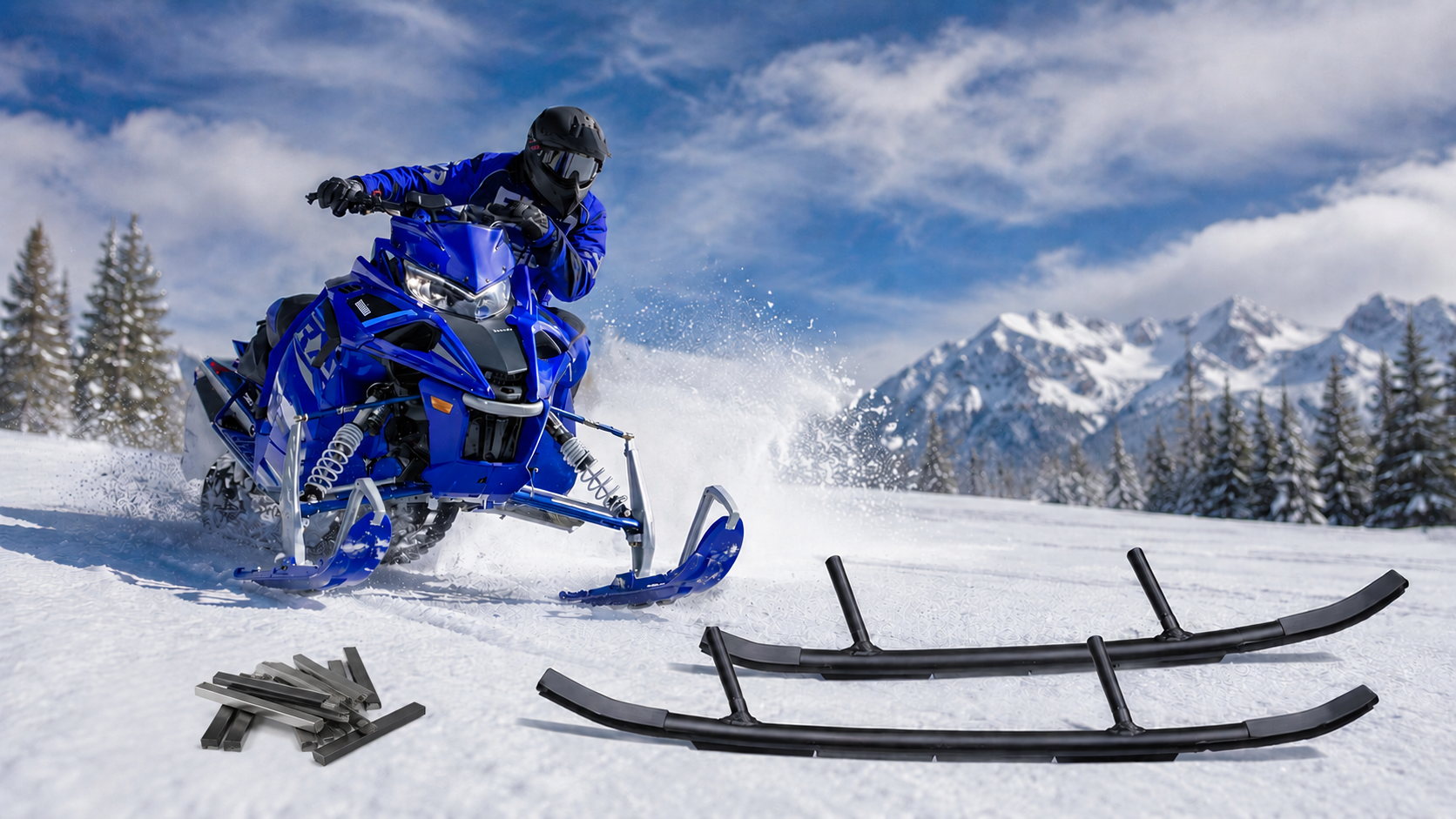
The snowmobile industry is entering a new stage of development where performance, durability, and rider confidence are becoming the primary factors influencing purchasing decisions. While engines, suspension systems, and track technology often receive the most attention, another component is quietly becoming more important than ever—the tungsten carbide wear bar.
For decades, wear bars have been regarded as a standard replacement part. Today, however, they are increasingly recognized as a key contributor to steering accuracy, safety, and overall riding performance. As snowmobile manufacturers continue to improve vehicle capabilities and riders demand more consistent handling across a wide range of winter conditions, the expectations placed on wear bars have changed significantly.
At the same time, the global market for snowmobile parts and accessories continues to expand. Industry analysts expect steady growth over the coming decade, driven by increasing interest in winter recreation, stronger demand for performance upgrades, and the continued expansion of both OEM and aftermarket sales channels. Performance-oriented components are among the fastest-growing product categories, reflecting riders' willingness to invest in parts that improve reliability and control.
These trends are creating new opportunities for manufacturers specializing in high-quality tungsten carbide components.
Wear Bars Are Becoming a Performance Component Instead of a Wear Item
In the past, many snowmobile owners viewed wear bars simply as consumable parts that needed periodic replacement. Purchasing decisions were often based primarily on price.
Today, that mindset is changing.
Modern riders understand that the quality of a wear bar directly affects steering response, cornering stability, and rider confidence. Whether riding on groomed trails, icy surfaces, packed snow, or mixed terrain, a premium carbide wear bar provides more predictable handling while reducing unwanted ski movement.
As vehicle performance continues to improve, steering components are subjected to greater loads than ever before. More powerful engines, advanced suspension systems, and higher average riding speeds mean that wear bars must withstand increased impact forces without sacrificing durability.
Rather than asking how inexpensive a wear bar is, many professional riders and fleet operators now ask how long it will maintain consistent steering performance.
Higher Expectations Are Driving Material Upgrades
One of the most noticeable changes in the industry is the growing demand for premium materials.
Traditional steel wear bars remain suitable for light recreational use, but many riders are upgrading to tungsten carbide because of its exceptional hardness and wear resistance.
Compared with conventional steel, tungsten carbide offers several advantages:
Significantly longer service life
Superior abrasion resistance
Improved steering precision
Better grip on icy trails
Lower maintenance frequency
Reduced long-term operating costs
For manufacturers, material selection has become an important competitive advantage. Customers increasingly expect products that deliver consistent performance throughout an entire riding season rather than requiring frequent replacement.
This shift aligns with broader trends across the global tungsten carbide industry, where demand for high-performance wear-resistant materials continues to grow across transportation, industrial manufacturing, mining, and precision engineering applications.
The Aftermarket Is Expanding Alongside OEM Demand
Another major trend shaping the industry is the rapid growth of the aftermarket.
Snowmobile owners are becoming more interested in customizing their machines to match their riding style and local trail conditions. Instead of replacing worn components with standard parts, many choose upgraded solutions that offer better durability and handling.
Industry reports show that increasing demand for customization and performance upgrades is one of the primary drivers of growth within the global snowmobile parts market. At the same time, online distribution channels have made premium components more accessible to riders around the world.
For manufacturers of tungsten carbide wear bars, this trend creates opportunities beyond traditional OEM supply.
Distributors, private-label brands, and aftermarket retailers are actively seeking manufacturing partners capable of producing consistent, high-quality wear bars while supporting customized specifications and reliable delivery schedules.
Why Premium Tungsten Carbide Grades Are Becoming the Industry Standard
As performance expectations continue to rise, the materials used in wear bar manufacturing have become a key differentiator.
Many leading manufacturers are moving beyond conventional carbide grades and adopting fine-grain or micro-grain tungsten carbide. These advanced materials provide an improved balance of hardness and fracture toughness, allowing wear bars to maintain excellent wear resistance while withstanding repeated impacts from icy trails, exposed rocks, and frozen ground.
For snowmobile riders, this translates into more consistent steering throughout the riding season. Instead of experiencing rapid wear or uneven carbide loss, high-quality wear bars retain their geometry longer, helping maintain predictable handling under changing trail conditions.
Material quality has therefore become just as important as wear bar design. Manufacturers capable of producing carbide with stable density, uniform grain structure, and consistent mechanical properties are increasingly preferred by OEM customers and aftermarket brands.
Manufacturing Precision Matters More Than Ever
Although tungsten carbide receives most of the attention, manufacturing precision plays an equally important role in determining the final performance of a wear bar.
Every stage of production—from powder preparation and sintering to carbide grinding, brazing, straightness inspection, and final quality control—directly influences durability and service life.
Poor brazing quality may result in carbide inserts separating from the steel body under heavy impact. Inconsistent grinding can lead to uneven steering performance. Dimensional deviations may affect installation accuracy and customer satisfaction.
As a result, professional buyers are paying greater attention to manufacturing capabilities rather than simply comparing product prices.
Reliable suppliers are expected to deliver:
Stable carbide material properties
Accurate dimensional tolerances
Strong brazed joints
Consistent hardness
Reliable production capacity
Batch-to-batch quality consistency
These factors have become increasingly important for OEM production programs and private-label aftermarket brands seeking long-term manufacturing partners.
OEM Buyers Are Looking Beyond Price
Procurement strategies within the snowmobile industry are also evolving.
Instead of focusing solely on unit cost, many OEM manufacturers and distributors are evaluating suppliers based on their ability to deliver long-term value.
Key purchasing considerations now include:
Product consistency across multiple production batches
Flexible customization capabilities
Reliable delivery schedules
Technical engineering support
Stable raw material sourcing
International quality standards
Long-term manufacturing partnerships
This shift reflects broader trends across the global manufacturing sector, where supply chain resilience and dependable quality have become critical competitive advantages.
For suppliers specializing in tungsten carbide components, investing in advanced production technology and strict quality management is becoming essential for maintaining competitiveness in international markets.
Sustainability Is Also Influencing Product Development
Environmental considerations are playing a growing role in industrial manufacturing, including snowmobile components.
Longer-lasting wear bars reduce replacement frequency, helping minimize material consumption throughout the product lifecycle. Extended service life also reduces maintenance requirements for riders and commercial fleet operators.
Meanwhile, improvements in tungsten carbide recycling technologies are supporting more efficient use of raw materials while helping manufacturers reduce production waste.
Although performance remains the primary purchasing factor, sustainability is increasingly viewed as an added benefit by OEM customers seeking responsible supply chain partners.
Outlook for the Global Wear Bar Market
Looking ahead, industry analysts expect continued demand for premium snowmobile components as riders place greater emphasis on durability, safety, and long-term value.
Several trends are expected to shape the market over the coming years:
Continued growth in the global snowmobile aftermarket
Increasing adoption of premium performance accessories
Higher demand for OEM-quality replacement parts
Greater use of advanced tungsten carbide materials
Increased emphasis on manufacturing consistency and quality assurance
Growing interest in customized wear bar solutions for different riding conditions
As these trends continue, manufacturers capable of combining advanced carbide technology with precision manufacturing and dependable supply chains will be well positioned to support both OEM production and aftermarket growth.
Conclusion
The role of tungsten carbide wear bars is evolving alongside the snowmobile industry itself.
What was once considered a routine replacement component has become an important contributor to vehicle performance, rider confidence, and long-term operating value. As expectations for steering precision, durability, and product reliability continue to increase, manufacturers are placing greater emphasis on material quality, production accuracy, and engineering consistency.
For companies serving the global snowmobile industry, delivering high-quality tungsten carbide wear bars is no longer simply about supplying components—it is about supporting the next generation of winter performance.
About Brace Carbide
Brace Carbide specializes in the development and manufacture of high-performance tungsten carbide wear parts for demanding industrial applications. With extensive experience in carbide materials, precision machining, and customized manufacturing, the company supports OEM customers, distributors, and aftermarket brands worldwide.
From carbide inserts to complete wear bar solutions, Brace Carbide is committed to delivering consistent quality, reliable production capacity, and flexible customization services that help customers compete in today's evolving market.