
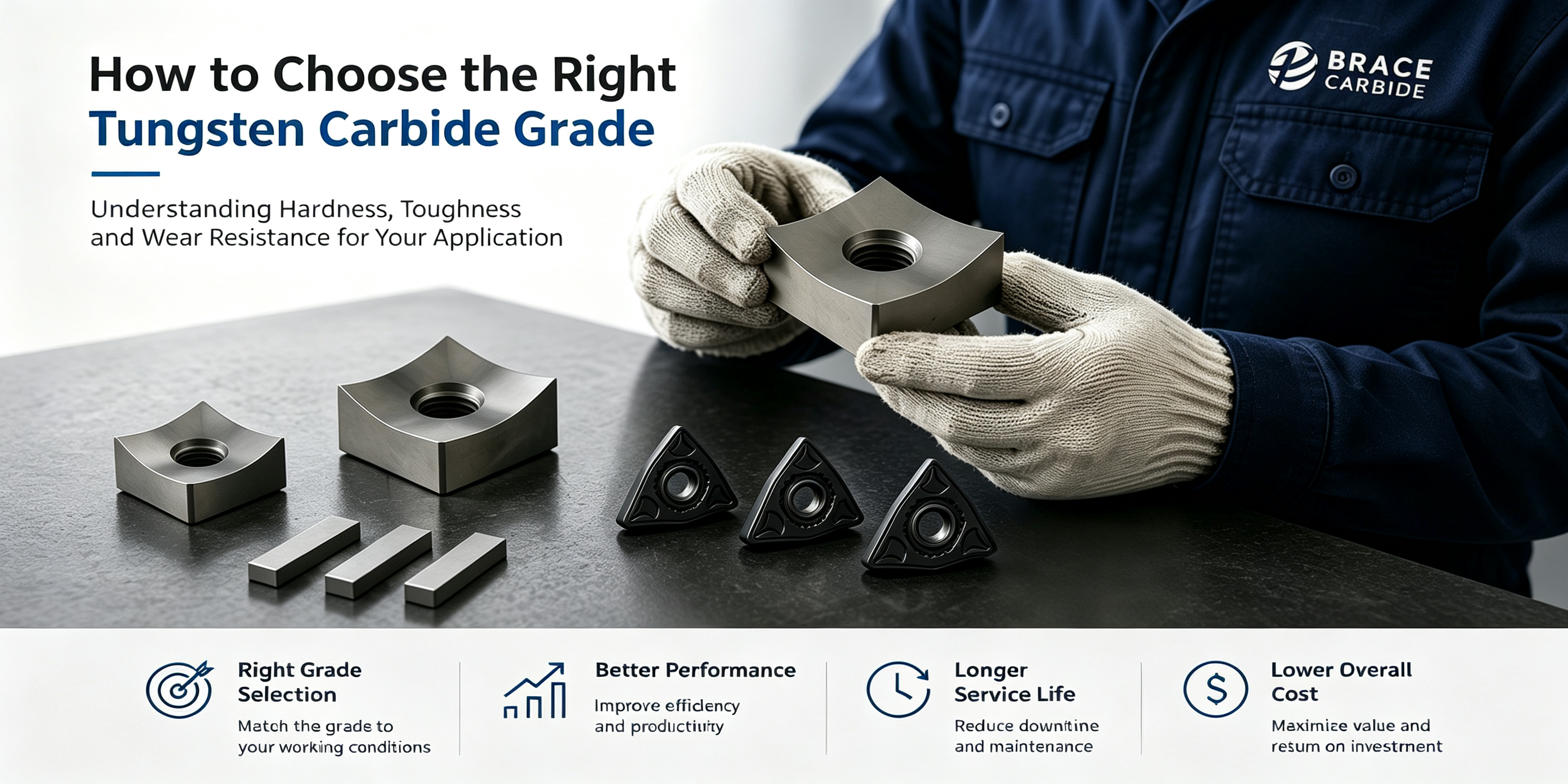
Tungsten carbide is widely used in industries where wear resistance, durability, and dimensional stability are critical. From recycling equipment and mining machinery to customized industrial components, carbide materials help improve equipment performance and reduce maintenance requirements.
However, selecting tungsten carbide is not simply about choosing the hardest material available.
Different applications create different challenges. A component working under severe abrasion may require a different carbide grade from a part exposed to heavy impact or vibration.
Choosing the right tungsten carbide grade requires understanding the relationship between hardness, toughness, wear resistance, and actual working conditions.
For industrial buyers, the correct material selection can directly influence:
• Component service life
• Equipment operating efficiency
• Maintenance frequency
• Overall production costs
Understanding Tungsten Carbide Grades
Tungsten carbide is a composite material mainly made from tungsten carbide particles and a metallic binder, usually cobalt.
The tungsten carbide phase provides high hardness and wear resistance, while the binder improves toughness and resistance to impact.
By adjusting carbide composition, grain size, and cobalt content, manufacturers can produce different grades designed for specific applications.
A carbide grade with higher hardness may perform extremely well in abrasive environments, but it may not always be the best option when strong impact forces are involved.
This is why professional carbide selection focuses on application requirements rather than simply choosing the hardest grade.
Why Tungsten Carbide Grade Selection Is Important
In industrial applications, component failure often results from selecting a material that does not match the operating environment.
For example, a shredder blade used in recycling applications may experience continuous abrasion together with unexpected impact from foreign materials.
If the carbide grade is too hard but lacks toughness, cracking or edge damage may occur.
If the material is too tough but lacks wear resistance, the component may wear faster and require frequent replacement.
The right carbide solution should provide a balance between wear performance and mechanical reliability.
Factors to Consider When Choosing Tungsten Carbide Grades
Wear Conditions
Wear resistance is usually one of the first factors considered during carbide selection.
Applications involving continuous material contact require carbide grades that can maintain cutting performance and dimensional stability over long operating periods.
Typical applications include:
• Plastic recycling blades
• Tire recycling components
• Crusher wear parts
• Industrial cutting components
In these environments, carbide grades with excellent abrasion resistance can significantly extend component service life.
Impact and Toughness Requirements
Wear is not the only challenge faced by industrial components.
Many parts also experience:
• Mechanical impact
• Vibration
• Sudden loading
• Material collision
For example, recycling equipment may encounter hard materials mixed with the processed material. In this situation, a carbide grade with higher toughness may provide better reliability.
The goal is not maximum hardness, but the right balance between hardness and toughness.
Operating Environment
The working environment also affects carbide performance.
Important factors include:
• Processed material characteristics
• Equipment design
• Cutting speed
• Contact pressure
• Operating temperature
A carbide grade that performs well in one application may not achieve the same results in another environment.
This is why experienced manufacturers evaluate the complete working condition before recommending a material solution.
Common Applications and Carbide Selection Considerations
Different industries have different performance requirements.
For plastic recycling blades, wear resistance and stable cutting performance are usually the main considerations.
For tire recycling applications, the material needs to handle both abrasion and impact.
For mining components, toughness and resistance to harsh working conditions are often more important because the parts are exposed to heavy loads and continuous impact.
For precision cutting tools, higher hardness and edge retention are usually key requirements.
Why Working With an Experienced Carbide Manufacturer Matters
Choosing tungsten carbide requires more than selecting a material grade from a catalog.
A professional manufacturer considers:
• Application conditions
• Component design
• Expected service life
• Production requirements
• Performance expectations
Manufacturing experience allows suppliers to recommend more suitable carbide solutions and avoid unnecessary material selection mistakes.
For customized tungsten carbide parts, this technical support becomes especially important because product performance depends on both material selection and manufacturing accuracy.
Customized Tungsten Carbide Solutions from Brace Carbide
Brace Carbide specializes in manufacturing tungsten carbide components for industrial applications.
Our products are used in demanding environments where wear resistance, reliability, and consistent performance are essential.
Our capabilities include:
• Tungsten carbide shredder blades
• Industrial wear parts
• Customized carbide components
• OEM carbide solutions
We work with customers to understand their operating conditions and recommend suitable carbide solutions based on actual application requirements.
Instead of focusing only on hardness values, we focus on helping customers achieve longer service life and more stable equipment performance.
Conclusion
Selecting the right tungsten carbide grade is an important decision for industrial buyers.
The best carbide material is not always the hardest option. The ideal solution depends on the balance between hardness, toughness, wear resistance, and working conditions.
By choosing the right carbide grade and working with an experienced manufacturer, companies can improve equipment reliability, reduce maintenance requirements, and achieve better long-term value.
For industries that depend on wear-resistant components, professional material selection is an important part of building reliable production systems.
Frequently Asked Questions
What is the best tungsten carbide grade for wear resistance?
The best grade depends on the application. High hardness grades generally provide excellent abrasion resistance, but the operating environment and impact conditions must also be considered.
Is higher hardness always better for tungsten carbide?
No. Higher hardness can improve wear resistance, but excessive hardness may reduce toughness. Applications involving impact usually require a better balance between hardness and toughness.
What tungsten carbide grade is suitable for shredder blades?
Shredder blades usually require a combination of wear resistance and toughness because they operate under abrasive conditions and may experience unexpected impact.
Can tungsten carbide grades be customized?
Yes. Professional carbide manufacturers can recommend or develop suitable carbide solutions according to application requirements, dimensions, and performance expectations.
How should I choose a tungsten carbide supplier?
A reliable supplier should provide not only products but also technical support, material recommendations, quality control, and customized manufacturing capability.