
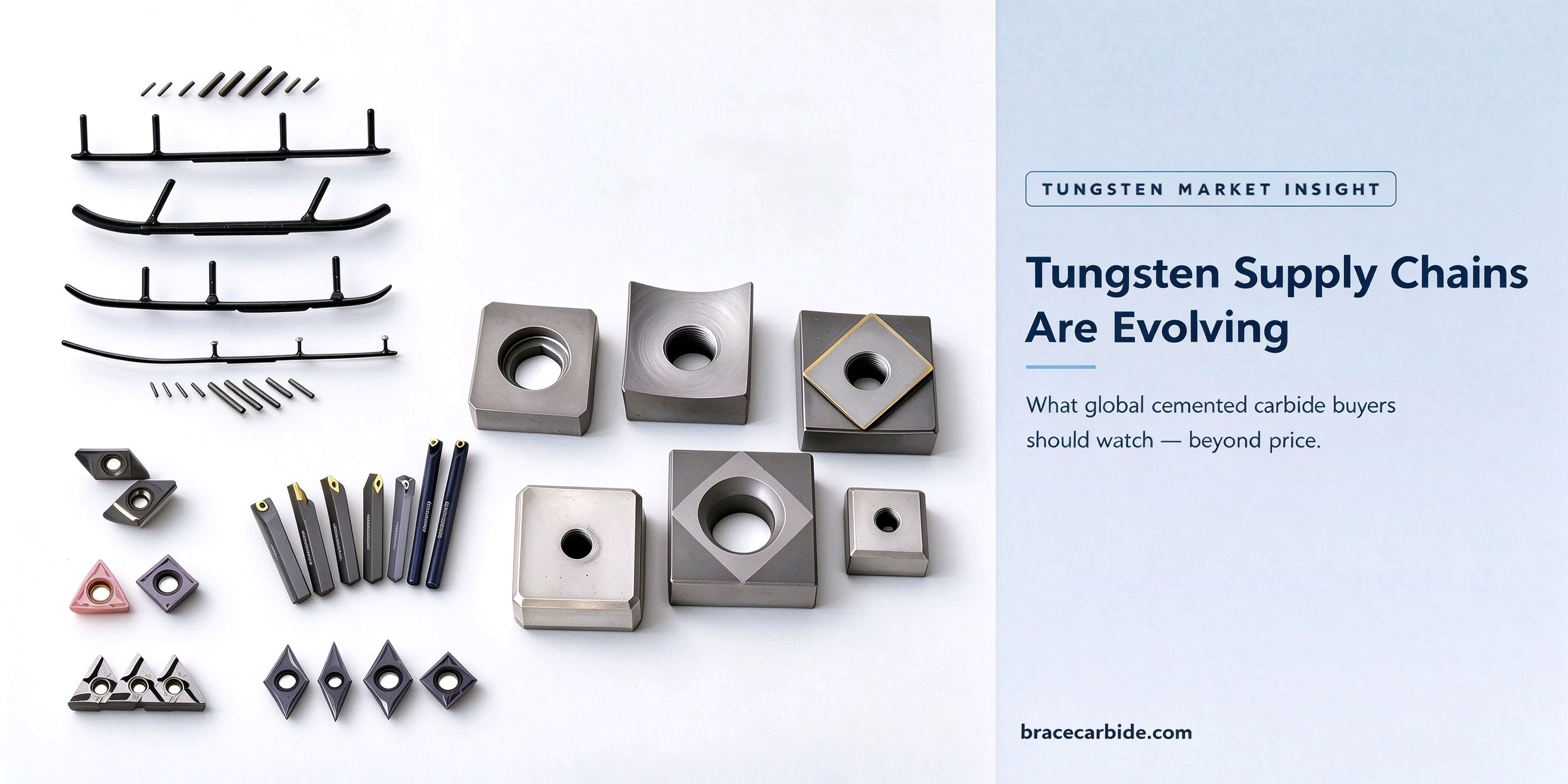
Tungsten remains an important raw material for the cemented carbide industry. It is used in products that require high hardness, wear resistance and performance under demanding industrial conditions.
However, the global tungsten supply chain is not standing still. Changes in China's domestic market, developments in new mining projects and growing attention to supply diversification are creating new considerations for manufacturers and international buyers.
For companies purchasing cemented carbide components, understanding these developments is important. Raw material prices remain relevant, but the origin of materials, supply reliability, product specifications and long-term procurement planning also deserve attention.
This article reviews several recent developments in the tungsten industry and discusses what they may mean for global cemented carbide buyers.
1. China's Tungsten Market: Demand and Purchasing Activity
China plays a major role in the global tungsten industry, making developments in its domestic market particularly relevant to international buyers.
According to a market review published on October 5, 2026, China's domestic tungsten market weakened during September. The report noted that the expected seasonal improvement in demand did not materialize as anticipated. Buyers remained cautious about restocking, while prices for tungsten concentrate, ammonium paratungstate (APT) and tungsten powder moved lower during the month.
This market behavior highlights an important distinction between raw material availability and purchasing demand.
Even when tungsten remains an important industrial material, downstream manufacturers may adjust their purchasing volumes according to production schedules, existing inventories and quotation conditions.
For cemented carbide manufacturers and buyers, changes in the upstream market can influence procurement discussions. However, raw material market movements do not automatically translate into equivalent changes in finished carbide product prices.
Finished products also involve material composition, processing requirements, product dimensions, machining and quality control.
Therefore, buyers should evaluate quotations according to actual product specifications and quotation dates rather than relying solely on general tungsten market trends.
2. New Tungsten Supply Developments Outside China
Another important development is the progress of tungsten projects outside China.
Although China remains a major source of global tungsten supply, new mining and processing developments in other countries are receiving attention from the industry.
Two recent developments in South Korea and Rwanda illustrate this trend.
South Korea: First Tungsten Concentrate from the Sangdong Mine
On September 29, 2026, Almonty Industries reported that its Sangdong mine in South Korea had produced its first tungsten concentrate.
The development marks the return of production at the mine after more than three decades.
According to the October 2026 critical minerals market review, the project's first phase was operating, while a second phase was planned for 2027.
The restart is relevant to the global tungsten industry because it represents progress toward additional production outside the traditional major supply regions.
However, the first production milestone should not be confused with full production capacity or immediate changes in global market supply.
For buyers, the development is worth monitoring as the project progresses through its production and expansion stages.
Rwanda: A New Partnership to Develop Tungsten Supply
Another development occurred in Rwanda.
On September 14, 2026, Almonty Industries and the Government of Rwanda announced a joint venture involving the collection, upgrading and export of tungsten from existing licensed producers, including small-scale mining operations.
The arrangement is intended to connect local tungsten production with international customers.
However, the development also highlights the importance of traceability.
Where supply involves multiple small-scale producers, buyers and downstream processors need to understand how materials are sourced and documented.
A broader range of supply origins can provide additional procurement options, but origin diversification alone does not guarantee consistent quality, availability or delivery.
For industrial buyers, supplier verification and material documentation remain important.
3. Why Supply Diversification Matters to Cemented Carbide Buyers
The development of new tungsten supply projects raises an important question: why should a buyer of finished cemented carbide products pay attention to mining projects?
The reason is that the tungsten supply chain is interconnected.
Tungsten ore is processed into intermediate materials such as APT, which can then be converted into tungsten powder and tungsten carbide powder. These materials are used in the production of cemented carbide products.
Changes at the mining and processing stages can influence the availability and sourcing options of materials further downstream.
For manufacturers and industrial buyers, supply diversification can be relevant for several reasons.
Procurement flexibility
Having access to different qualified suppliers and material sources may provide additional options when purchasing conditions change.
Supply continuity
Companies should understand the sourcing arrangements behind the materials used in their products, particularly when uninterrupted production is important.
Origin and traceability
Material origin and supporting documentation may be relevant to customers with specific sourcing, compliance or supply-chain requirements.
Long-term planning
New mining projects take time to develop. Their production progress should be evaluated over time rather than assumed to create immediate changes in material availability.
It is important to remember that additional supply sources do not automatically mean lower prices. Production costs, processing capacity, transportation, market demand and material quality also influence the economics of tungsten supply.
4. Raw Material Prices Are Only One Part of Procurement Decisions
Tungsten price movements often receive considerable attention because tungsten is a major component of many cemented carbide materials.
However, purchasing decisions for finished carbide components involve more than the cost of raw materials.
A custom carbide blade, wear part or precision component may require specific dimensions, tolerances, material grades and machining operations.
These requirements can affect the final quotation independently of changes in the upstream tungsten market.
For example, two carbide components may have similar external dimensions but different material compositions or manufacturing requirements.
Their prices should therefore not be compared without considering the complete specifications.
When evaluating a carbide quotation, buyers should pay attention to:
Carbide grade and material composition
Product dimensions and tolerances
Manufacturing and finishing requirements
Order quantity
Inspection and quality requirements
Delivery schedule
Quotation validity
A clear specification makes it easier for both the buyer and manufacturer to evaluate whether different quotations are genuinely comparable.
5. Material Selection Should Match the Application
Choosing a suitable cemented carbide grade is another important part of procurement planning.
Cemented carbide materials are designed to provide different combinations of hardness, wear resistance and toughness.
The appropriate balance depends on the working conditions.
For applications involving abrasive wear, wear resistance may be a major consideration. For components exposed to repeated impact, toughness also becomes important.
In many industrial applications, both factors need to be considered together.
For example, shredder blades used in tire, plastic and industrial waste processing operate under different conditions depending on the processed material and machine configuration.
A blade designed for one application should not automatically be assumed suitable for another.
When developing a custom carbide component, buyers should provide information such as:
Material being processed
Machine configuration
Operating conditions
Existing blade dimensions
Required product geometry
Current material or grade, if known
Performance problems that need to be addressed
This information helps manufacturers understand the application before discussing possible material and product specifications.
6. What Should Global Buyers Check When Evaluating a Supplier?
As tungsten sourcing options develop, buyers should also pay attention to the capabilities and reliability of the suppliers they work with.
A competitive quotation is important, but it is only one part of the evaluation.
The following considerations can help buyers assess a potential carbide supplier.
Technical Communication
A supplier should be able to understand drawings, dimensions, material requirements and application details.
Clear technical communication helps reduce misunderstandings during product development and quotation.
Product Specifications
The buyer and manufacturer should agree on the material grade, dimensions, tolerances and other relevant technical requirements before production.
Quality Control
Quality inspection should be appropriate to the product and its specifications. Relevant checks may include dimensions, hardness and visual condition.
Production and Delivery Planning
Buyers should confirm production arrangements and delivery expectations according to their order requirements.
Repeat-Order Consistency
For replacement parts and OEM components, maintaining consistent product specifications across repeat orders is important.
These considerations are relevant whether a buyer purchases standard carbide materials or customized industrial components.
7. The Growing Importance of Customized Carbide Components
Many industrial applications require components designed for specific machines and operating conditions.
Standardized products can be suitable when dimensions and performance requirements are common. However, replacement parts and specialized equipment may require customized dimensions, geometries or material specifications.
Customization allows buyers to communicate their actual requirements rather than selecting a product solely from a standard catalogue.
This is particularly relevant for:
Shredder blades
Blade dimensions and configurations need to correspond to the equipment and material being processed.
Carbide wear parts
Material selection and product geometry should reflect the actual wear conditions.
Precision carbide components
Dimensional requirements and machining specifications need to be clearly defined.
Carbide rods and plates
Dimensions and material requirements should be selected according to the intended manufacturing or industrial application.
For these products, drawings, samples and detailed application information provide a useful starting point for technical discussions.
8. Brace Carbide: Custom Tungsten Carbide Solutions
At Brace Carbide, we focus on customized cemented carbide products for industrial customers.
Our product range includes custom carbide blades, shredder blades and knives, carbide wear parts, rods, plates and precision cemented carbide components.
We work with customer drawings, dimensions, samples and application requirements to discuss product specifications.
Rather than limiting every enquiry to fixed standard models, we focus on understanding the customer's requirements and discussing suitable customized product solutions.
For customers sourcing replacement parts or developing components for specific equipment, providing a drawing or sample can help establish the technical requirements.
Whether you are looking for carbide blades, industrial wear parts or other customized tungsten carbide products, our team welcomes your enquiry.
Visit our website to learn more:
Conclusion: Looking Beyond the Immediate Tungsten Market
Recent developments in China, South Korea and Rwanda show that the global tungsten supply chain continues to evolve.
China's domestic market conditions remain important, while new mining developments outside China are creating additional areas for the industry to monitor.
However, new projects should be evaluated according to their actual production progress, material quality and ability to supply international customers.
For cemented carbide buyers, the most practical approach is to consider raw material conditions together with supplier reliability, product specifications, material selection and application requirements.
A well-defined purchasing strategy should look beyond the immediate price of tungsten and focus on the complete requirements of the finished carbide component.
Brace Carbide provides customized tungsten carbide solutions for industrial applications.
Contact us with your drawings, samples, dimensions or application requirements to discuss your next carbide project.