
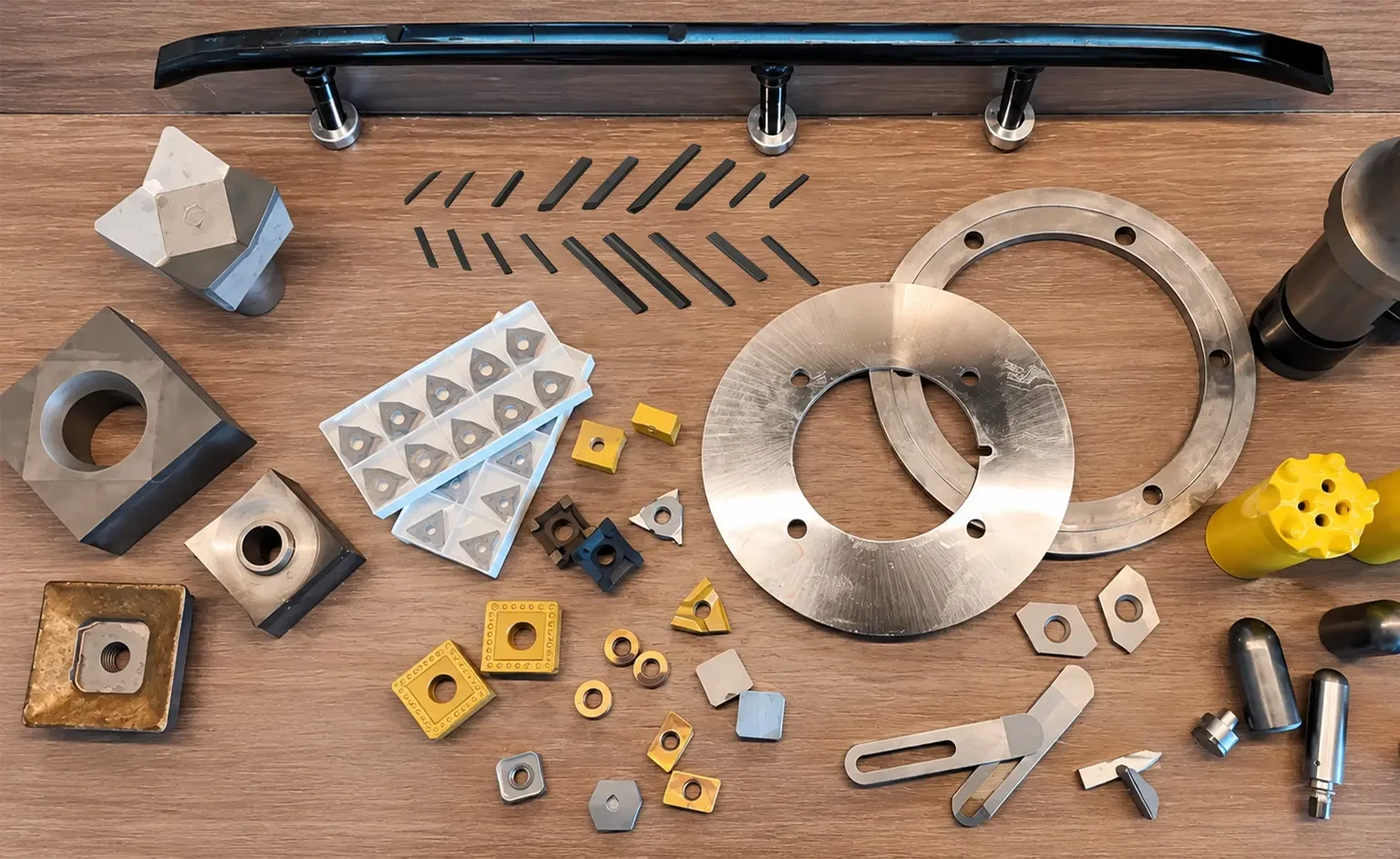
What Makes Custom Tungsten Carbide Components Challenging to Manufacture?
Tungsten carbide is widely used in industrial machinery, cutting systems, precision components and wear-resistant applications. Its combination of hardness, strength and dimensional stability makes it suitable for manufacturing components that operate under demanding industrial conditions.
However, producing standard carbide products and manufacturing custom tungsten carbide components are two different processes.
Standard products often follow established dimensions and manufacturing procedures. Custom components, on the other hand, may involve irregular geometries, special installation structures, tight dimensional requirements or machining features designed for specific equipment.
A component that appears relatively simple on a technical drawing may require several manufacturing considerations before production can begin.
From powder preparation and forming to sintering, precision machining and final inspection, each stage can influence the quality and dimensional accuracy of the finished product.
So, what makes custom tungsten carbide components challenging to manufacture?
1. Complex Geometries and Non-Standard Component Designs
One of the first challenges in custom carbide manufacturing is the geometry of the component.
Industrial buyers may require carbide parts with irregular profiles, multiple steps, narrow grooves, special-shaped surfaces, holes or other non-standard structural features.
Unlike conventional cylindrical rods, flat plates or simple inserts, these components may require individual evaluation before a suitable manufacturing process can be determined.
Several design features can increase manufacturing complexity:
Irregular profiles
Components with curved edges, angled surfaces or non-standard outlines may require dedicated forming tools or additional machining operations.
Narrow grooves and small openings
Small structural features can create limitations during forming and machining. Their dimensions and positions need to be evaluated carefully.
Thin sections
Parts with narrow edges or uneven cross-sections may require additional attention during forming, handling and sintering.
Multi-level structures
Components with several different heights, steps or working surfaces may require more complex dimensional control.
The feasibility of a particular design depends on the material composition, overall dimensions, forming method and required final specifications.
For this reason, custom carbide manufacturing should begin with an evaluation of the complete component structure rather than simply copying the external shape of a drawing.
2. Wall Thickness and Structural Design
Wall thickness is another important factor when developing non-standard carbide components.
Unlike many conventional metal parts, cemented carbide components have specific forming and processing considerations that must be taken into account during product design.
A component with significantly different wall thicknesses may not behave uniformly during forming and subsequent sintering.
For example, transitions between thick and thin sections can introduce differences in material flow, density distribution and dimensional changes.
Sharp internal corners, narrow projections and very thin edges may also create additional manufacturing difficulties.
When designing custom carbide components, several details deserve attention:
Maintain reasonably consistent section thickness where the application allows.
Avoid unnecessary sharp transitions between different cross-sections.
Evaluate narrow projections and thin edges before finalizing the design.
Consider the relationship between the component's geometry and its forming method.
Identify critical functional surfaces and dimensions.
These considerations do not mean that every component must have a simple shape.
Many industrial applications genuinely require complicated structures. The objective is to understand how the design influences manufacturing and determine whether adjustments are necessary before production.
Early communication between the buyer and manufacturer can help identify potential design limitations and avoid unnecessary revisions later.
3. Powder Preparation and Forming Requirements
Cemented carbide manufacturing begins with powder preparation.
The material typically consists of tungsten carbide particles combined with a metallic binder, commonly cobalt in conventional WC-Co grades.
The preparation process involves controlling the material composition and preparing the powder mixture for subsequent forming.
Depending on the product and manufacturing route, powder preparation may involve mixing, milling, drying and granulation.
The next stage is forming.
Common forming methods used in cemented carbide production include die pressing, extrusion and other specialized forming processes.
The appropriate method depends on the component's geometry, dimensions, material requirements and production conditions.
For custom products, the forming stage can present several challenges.
Tooling considerations
Non-standard components may require specially designed molds or pressing tools. Their structural features must be compatible with the selected forming method.
Powder distribution
Uniform powder distribution is important for obtaining consistent compact characteristics.
Green compact strength
Before sintering, the formed component is known as a green compact. Its ability to maintain the intended shape during handling and subsequent processing is an important consideration.
Forming complexity
Some geometries are more difficult to produce through conventional pressing methods and may require a different manufacturing approach.
A well-planned forming process provides the foundation for subsequent sintering and machining operations.
4. Sintering and Dimensional Shrinkage
Sintering is one of the most important stages in cemented carbide manufacturing.
During this process, the formed compact is heated under controlled conditions, allowing the material to densify and develop its final structure.
One important characteristic of sintering is dimensional shrinkage.
The dimensions of the compact before sintering are not necessarily the same as the final dimensions of the finished component.
This means that manufacturers must consider shrinkage when determining the initial forming dimensions.
The amount of dimensional change is influenced by several factors, including:
Material composition
Powder characteristics
Initial compact density
Forming conditions
Sintering process parameters
Component geometry
For custom components, this becomes especially important when the design includes multiple sections with different thicknesses or complex profiles.
Uneven dimensional changes can create additional challenges when the final product must meet specific dimensional requirements.
Manufacturing planning therefore needs to account for the complete process rather than treating forming and sintering as independent operations.
5. Machining and Surface Finishing After Sintering
After sintering, certain cemented carbide components may require additional machining to achieve their specified dimensions, profiles or surface conditions.
Because sintered tungsten carbide is extremely hard, conventional machining methods are not suitable for every finishing requirement.
Depending on the component design and technical specifications, different processing methods may be considered.
Diamond Grinding
Diamond grinding is commonly used for finishing cemented carbide components because diamond abrasives are suitable for machining hard carbide materials.
It can be used to achieve specified dimensions, flat surfaces and particular geometric features.
Electrical Discharge Machining (EDM)
EDM may be used for certain electrically conductive cemented carbide materials when the component requires specific shapes or features that are difficult to obtain through conventional grinding.
Its suitability depends on the material and required surface condition.
Surface Finishing
Certain applications require additional attention to surface roughness, edge conditions or contact surfaces.
The required finishing method depends on the component's intended function.
Not every custom carbide part requires the same machining operations.
Some products can be produced with relatively simple finishing requirements, while others may involve multiple machining stages.
This is why machining requirements should be evaluated during the initial design review instead of being considered only after the component has been formed.
6. Dimensional Tolerances and Geometric Accuracy
Dimensional accuracy is another major consideration in custom tungsten carbide manufacturing.
In many industrial applications, carbide components must fit into existing machinery or work together with other mechanical parts.
Even relatively small dimensional deviations can influence installation, positioning or the relationship between connected components.
However, dimensional accuracy involves more than checking length, width and thickness.
Depending on the component design, other specifications may also be important.
Dimensional tolerances
These define the acceptable variation in measurements such as length, width, thickness, diameter and other critical dimensions.
Flatness
For components with mounting or contact surfaces, flatness may influence how the part fits against another surface.
Parallelism
Parallel surfaces may be necessary for components that require consistent positioning or contact.
Perpendicularity
The relationship between intersecting surfaces may affect installation and mechanical alignment.
Profile accuracy
Special-shaped components may require inspection of their overall profiles rather than only individual dimensions.
For buyers, clearly identifying critical dimensions on technical drawings is extremely helpful.
Not every dimension needs the same tolerance requirement. Distinguishing functional dimensions from general dimensions helps manufacturers understand where precision is most important.
7. Assembly Compatibility and Installation Requirements
Many custom carbide products are not independent components.
They may be designed to work with steel bodies, holders, cutting systems, mechanical assemblies or existing industrial equipment.
In these situations, the carbide component must meet both its own dimensional requirements and the installation requirements of the complete assembly.
Important considerations may include:
Mounting dimensions and positioning
Contact surfaces
Connection structures
Welding or joining requirements, where applicable
Compatibility with existing mechanical components
Installation and replacement requirements
For example, a carbide insert designed for a particular machine may need to match the dimensions and positioning of an existing holder.
Similarly, a carbide component attached to a steel body may require consideration of the joining structure and the requirements of the complete assembly.
If these details are not clearly communicated during product development, the finished component may require additional adjustments during installation.
Providing assembly drawings, reference samples or information about the existing equipment can help manufacturers better understand the requirements.
8. Quality Inspection Throughout the Manufacturing Process
Quality inspection is not limited to measuring the finished component.
For custom cemented carbide products, different stages of manufacturing may require different types of checks.
The inspection requirements depend on the product specifications, customer requirements and the manufacturing process.
Several inspection aspects are commonly considered.
Material and Production Records
Material specifications and relevant production information help maintain traceability and consistency throughout the manufacturing process.
Dimensional Inspection
Critical dimensions can be checked against the technical drawing using suitable measuring instruments.
Hardness Testing
Hardness testing may be used when specified by the customer or required by the product specifications.
Surface and Visual Inspection
The component's appearance, visible defects, edges and surface condition can be checked according to the agreed acceptance requirements.
Geometric Inspection
For components with special profiles or geometric requirements, appropriate measurement methods may be necessary.
The specific inspection method should match the characteristic being evaluated.
For buyers, it is important to communicate inspection requirements before production, especially when the component has critical dimensions or specific acceptance criteria.
Clear inspection requirements help reduce misunderstandings between the manufacturer and the customer.
9. Design for Manufacturability: Making Custom Components Easier to Produce
Design for Manufacturability (DFM) means considering manufacturing limitations and practical production requirements during the product design stage.
For custom carbide components, this approach can help identify potential difficulties before production begins.
A technically functional design may still require adjustments if certain structural features are difficult to form, machine or inspect.
Several questions are worth considering during a design review:
Can the required geometry be produced using a suitable forming method?
Are the specified wall thicknesses practical?
Are there unnecessary sharp corners or complicated transitions?
Can critical surfaces be accessed during machining?
Are the dimensional tolerances appropriate for the actual application?
Can the finished component be inspected effectively?
Does the component fit the intended assembly?
The goal of DFM is not to change the customer's design unnecessarily.
Instead, it is to identify potential manufacturing issues and discuss possible solutions while preserving the component's intended function.
For OEM buyers developing new parts, early technical communication can be particularly valuable.
10. What Information Should Buyers Prepare for a Custom Carbide Order?
A clear technical specification makes it easier for manufacturers to evaluate a custom carbide project.
Before requesting a quotation, buyers should ideally prepare the following information.
Information | Purpose |
|---|---|
Technical drawings | Define component geometry and structure |
Overall dimensions | Establish product specifications |
Critical tolerances | Identify precision requirements |
Material or grade requirements | Clarify material expectations |
Application details | Explain the intended function |
Working environment | Provide information about operating conditions |
Assembly drawings | Clarify installation and compatibility |
Surface requirements | Define finishing expectations |
Order quantity | Support production planning |
If a complete technical drawing is not available, an existing sample, photographs or preliminary dimensions can still provide a useful starting point.
For new product development, discussing the design and manufacturing requirements before placing an order can help both parties establish a clearer understanding of the project.
Conclusion: Successful Custom Carbide Manufacturing Starts with the Right Technical Evaluation
Custom tungsten carbide manufacturing involves multiple considerations beyond producing a component in a particular shape.
Complex geometry, wall thickness, powder forming, sintering shrinkage, machining requirements, dimensional tolerances and assembly compatibility can all influence the final manufacturing approach.
These factors are closely connected. A design decision made during the early development stage may affect forming, machining and final inspection.
For this reason, custom carbide projects benefit from clear technical drawings, well-defined specifications and early communication between buyers and manufacturers.
At Zigong Brace Cemented Carbide Co., Ltd., we focus on customized cemented carbide products based on customer drawings, samples and dimensional requirements.
For industrial buyers and OEM manufacturers looking for non-standard carbide components, providing the relevant product information is a practical first step toward evaluating a suitable manufacturing solution.
Have a custom tungsten carbide component to develop?
Send us your drawings, samples or product requirements.
Contact Brace Carbide to discuss your project and explore a suitable customized carbide solution.
Website: https://bracecarbide.com/