
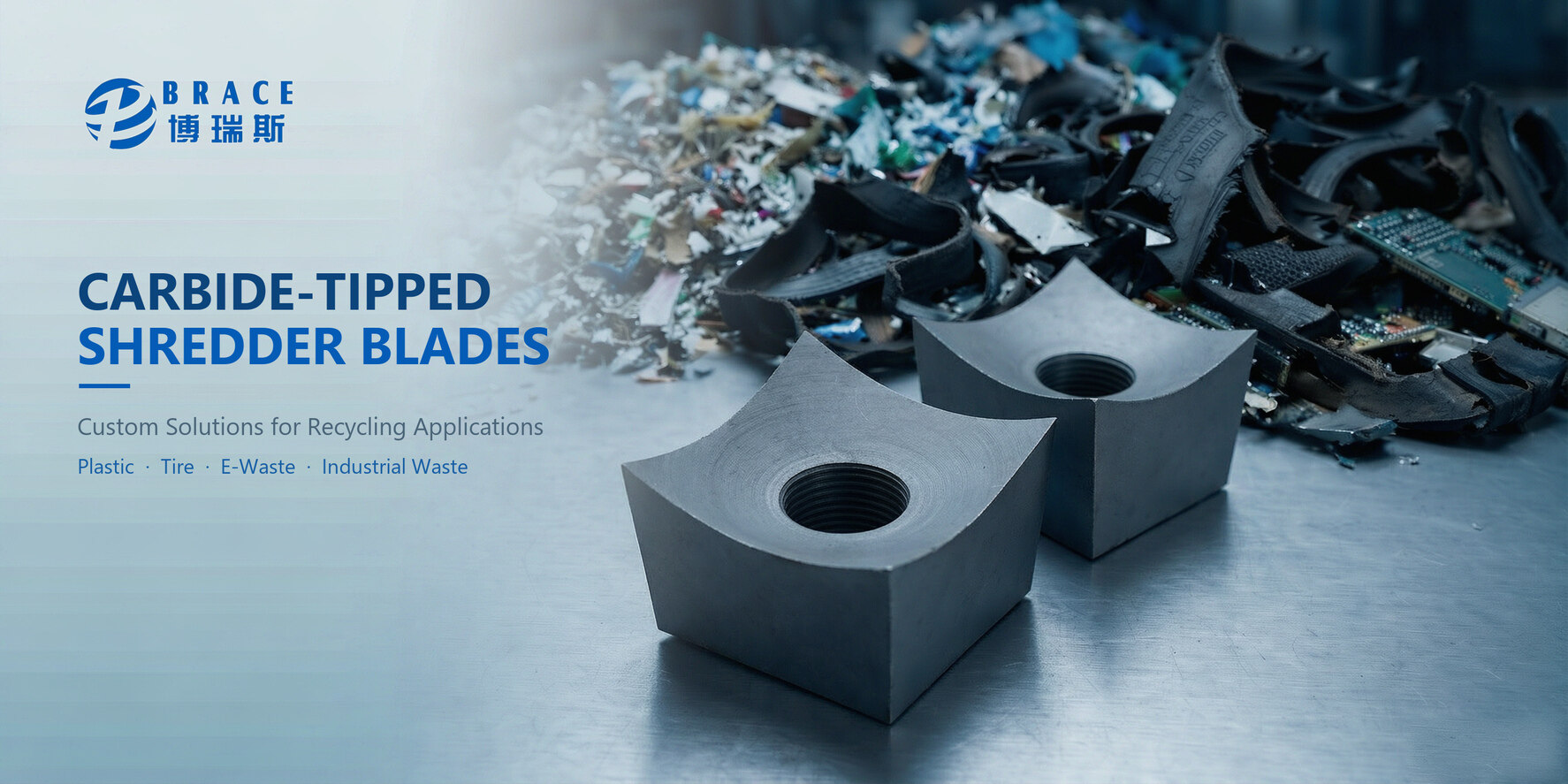
Industrial recycling equipment operates under demanding conditions.
Shredder blades may need to process plastics, tires, industrial waste, electronic waste, rubber, and other materials that can contain abrasive particles or unexpected hard contaminants.
For these applications, blade selection has a direct impact on cutting performance, maintenance frequency, and operating costs.
One solution is to combine a steel blade body with tungsten carbide cutting components.
This design combines the toughness of steel with the wear resistance of cemented carbide, making it suitable for many demanding shredding applications.
1. Why Use Tungsten Carbide on Shredder Blades?
Conventional steel blades can provide good toughness, but their cutting edges may wear relatively quickly when processing highly abrasive materials.
Tungsten carbide has significantly higher hardness and wear resistance than conventional steels.
When carbide is applied to the working area of a shredder blade, the carbide cutting section can provide improved resistance against abrasive wear while the steel body provides structural support.
This creates a practical combination:
Steel body → toughness and structural strength
Tungsten carbide → wear resistance and edge durability
The appropriate design depends on the actual application and working conditions.
2. Carbide-Tipped vs. Full Carbide Designs
Not every shredding application requires a fully solid carbide component.
For many industrial applications, a steel-body design with carbide working sections can provide a useful balance between performance and cost.
Carbide-tipped or carbide-insert design
The main body is manufactured from steel, while tungsten carbide is positioned at the working area.
Advantages can include:
Good structural toughness
High wear resistance at the cutting area
Suitable for heavy-duty applications
Flexible product dimensions
Practical manufacturing cost
Customizable carbide configuration
Solid carbide design
Solid cemented carbide can provide excellent wear resistance, but its higher hardness also means that application conditions need to be carefully considered.
For applications involving significant impact or shock loading, the overall blade design is especially important.
Therefore, the question is not simply:
“Which material is harder?”
It is:
“Which combination is suitable for the actual shredding conditions?”
3. Steel Body Selection Also Matters
The steel body supports the carbide components and transfers mechanical loads during operation.
Different applications may require different steel materials.
At Brace Carbide, customized shredder blades can be produced using steel options such as:
40Cr
45 Steel
40CrMo
The appropriate steel selection depends on factors such as blade dimensions, mechanical loading, impact conditions, and the customer's existing equipment.
A carbide component cannot be evaluated independently from the steel structure supporting it.
4. Carbide Grade Selection
The carbide grade is another important factor.
Different grades provide different balances of hardness, wear resistance, and toughness.
For example, our customized shredder blade solutions can use carbide grades such as:
YG10X
YG11C
YG15C
The appropriate grade should be selected according to the actual material being processed and the working conditions.
A highly abrasive application may require a different carbide solution from an application involving frequent impact or hard contaminants.
This is why grade selection should be based on application requirements rather than simply choosing the hardest available material.
5. Geometry Can Be Just as Important as Material
Material selection is only one part of shredder blade performance.
Blade geometry also affects:
Cutting efficiency
Contact area
Wear distribution
Material feeding
Stress concentration
Overall service life
For OEM applications, the blade can be manufactured according to customer drawings or samples.
Dimensions, hole positions, cutting profiles, carbide locations, and other specifications can be customized according to the equipment.
This is particularly important when replacing an existing blade with a customized carbide version.
6. Designed for Different Recycling Applications
Carbide-tipped and carbide-enhanced shredder blades can be used in a variety of recycling and size-reduction applications.
Typical applications include:
Plastic Recycling
Processing plastic waste can generate continuous abrasive wear, particularly when the feedstock contains fillers or contaminants.
Tire Recycling
Rubber and reinforced tire materials can place significant wear demands on cutting components.
Industrial Waste
Mixed industrial waste can contain materials with very different hardness and impact characteristics.
Electronic Waste
E-waste can contain hard components and mixed materials that create demanding cutting conditions.
Other Recycling Applications
Customized shredder blades can also be designed for other waste-processing and size-reduction systems according to customer requirements.
7. Custom Shredder Blades for Different Machines
A major advantage of customized shredder blades is that the product does not need to be limited to a fixed standard model.
We can manufacture according to:
Customer drawings
Existing samples
Blade dimensions
Mounting holes
Cutting geometry
Steel material
Carbide grade
Carbide configuration
This makes OEM/ODM production particularly useful when customers are looking for a replacement blade or want to upgrade an existing steel blade to a carbide-enhanced design.
You can learn more about our [Industrial Shredder Blades] for recycling and waste-processing applications.
8. What Information Do We Need for a Custom Shredder Blade?
If you are looking for a customized carbide shredder blade, the following information can help us evaluate the application:
1. Product drawing or sample
A drawing or existing blade sample is the best starting point.
2. Blade dimensions
Length, width, thickness, hole position, and other critical dimensions.
3. Material being processed
For example:
Plastic
Tires
Rubber
E-waste
Industrial waste
Mixed materials
4. Current blade material
If you are replacing an existing steel blade, please provide the current material or grade if available.
5. Working conditions
Information about impact, abrasion, production volume, and operating conditions can help with carbide grade selection.
6. Required quantity
This allows us to evaluate the appropriate production and quotation requirements.
9. Why Customization Matters
There is no single shredder blade specification that is ideal for every recycling application.
A blade processing clean plastic may have very different requirements from one processing tires or mixed industrial waste.
The carbide grade, steel body, geometry, carbide configuration, and dimensions should therefore be considered together.
For OEM customers, a customized solution can provide a better match with the existing machine and working conditions.
10. Brace Carbide Custom Shredder Blade Solutions
At Brace Carbide, we focus on customized tungsten carbide and cemented carbide solutions for industrial applications.
Our shredder blades can be customized according to customer drawings or samples, including different combinations of:
40Cr / 45 Steel / 40CrMo
with
YG10X / YG11C / YG15C
depending on the application requirements.
We support customized dimensions, carbide configurations, and OEM production for different shredding systems.
If you are currently using steel shredder blades and are looking for a more wear-resistant solution, send us your drawing, sample, or existing blade specifications.
We can evaluate the application and discuss a suitable carbide solution.
Conclusion
Carbide-tipped shredder blades offer a practical way to combine the toughness of a steel body with the wear resistance of tungsten carbide.
However, good performance depends on more than simply adding carbide.
Carbide grade + steel body + blade geometry + working conditions
all need to be considered together.
For recycling equipment manufacturers and industrial users, a customized blade design can provide a more suitable solution than simply selecting a standard product.
Looking for a custom carbide shredder blade?
Send us your drawing or sample and let us discuss the right solution for your application.
FAQ
What materials can carbide-tipped shredder blades process?
They can be designed for applications involving plastics, tires, rubber, industrial waste, electronic waste, and other materials, depending on the blade design and carbide grade.
What steel materials can be used?
Common options for our customized products include 40Cr, 45 Steel, and 40CrMo, depending on the application and mechanical requirements.
What carbide grades are available?
Customized solutions can use grades such as YG10X, YG11C, and YG15C, depending on the wear and impact conditions.
Can you manufacture blades according to drawings?
Yes. OEM/ODM production based on customer drawings or samples is one of our main strengths.
Can you customize the carbide position and geometry?
Yes. Product dimensions, mounting configuration, geometry, and carbide configuration can be customized according to the customer's requirements.