
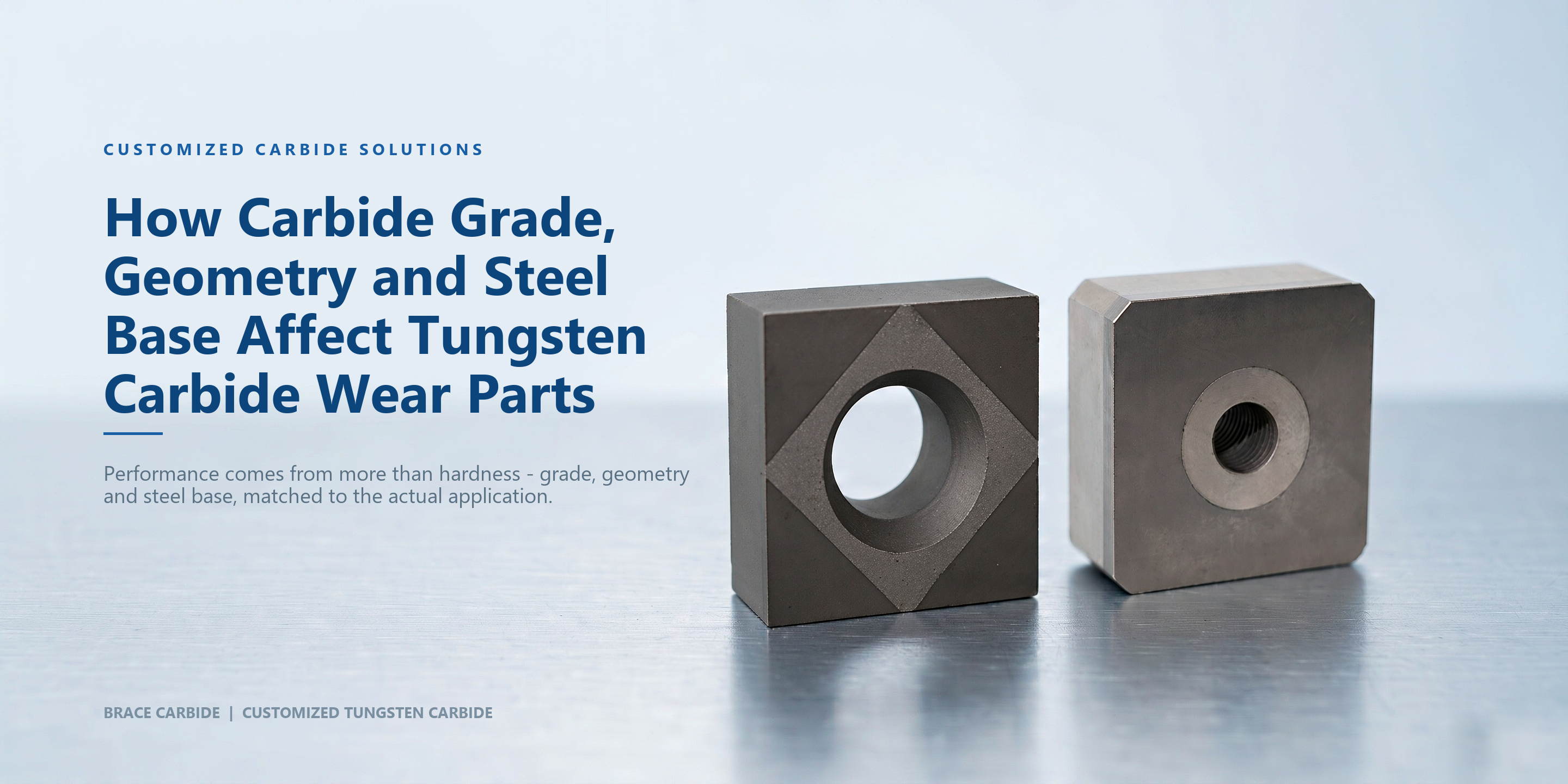
Tungsten carbide is widely used for industrial wear components because of its high hardness and excellent wear resistance.
However, simply choosing a tungsten carbide material does not automatically guarantee the best performance.
For customized tungsten carbide wear parts, several factors need to be considered together, including:
Carbide grade
Product geometry
Dimensions
Steel base material
Working conditions
Wear type
Expected service life
A wear part that performs well in one application may not be the best solution for another.
This is why customized carbide design is often more important than simply selecting the hardest available material.
1. Carbide Grade Affects the Balance Between Hardness and Toughness
Different industrial applications place different demands on carbide components.
Some applications involve mainly continuous abrasion, while others involve a combination of abrasion and impact.
Carbide grade selection therefore needs to consider the actual working environment.
In general, carbide grades are selected according to the required balance between:
Wear resistance + Hardness + Toughness
A grade optimized for high wear resistance may not necessarily be the best choice when the component experiences significant impact.
Likewise, a grade with greater toughness may be more suitable for applications where impact resistance is important.
For customized wear parts, the appropriate grade should therefore be considered together with the application rather than selected only according to a hardness value.
2. Geometry Can Be Just as Important as Material
Material selection is only one part of wear-part design.
The geometry of the carbide component can also affect how forces and wear are distributed during operation.
Depending on the application, designers may need to consider:
Length
Width
Thickness
Edge geometry
Carbide insert position
Contact area
Mounting method
Overall component shape
For example, a carbide component used as a wear surface may experience a very different load pattern from a carbide cutting component.
A customized geometry can help the carbide work more effectively within the equipment.
This is one reason why customer drawings and samples are particularly useful when developing custom carbide products.
3. The Steel Base Also Matters
Many industrial carbide wear components are not made from carbide alone.
Depending on the application, tungsten carbide may be combined with a steel base or support structure.
The steel base provides structural support, while the carbide provides the required wear-resistant surface or cutting performance.
The two materials therefore need to work together.
Important considerations can include:
Steel base material
Product dimensions
Carbide placement
Joining method
Operating loads
Impact conditions
Application environment
A carbide insert with excellent wear resistance may still underperform if the overall component design is not suitable for the application.
For this reason, customized carbide wear parts should be considered as a complete component, rather than simply a piece of carbide.
4. Wear Conditions Determine the Right Combination
Industrial wear does not occur in exactly the same way in every application.
Common wear conditions include:
Abrasive Wear
Hard particles continuously contact the component surface.
In these applications, wear resistance is usually a major consideration.
Impact
The component experiences repeated shocks or heavy loads.
In this situation, toughness and structural design become particularly important.
Combined Wear
Many real applications involve both abrasion and impact.
For these applications, the best solution may require a balance between carbide hardness and toughness rather than maximizing one property.
This is particularly relevant to industrial equipment such as recycling machinery, shredders and other demanding applications.
5. Why Standard Carbide Parts Are Not Always the Best Solution
Standard carbide products can be suitable for many applications.
However, industrial equipment often has specific requirements that cannot be addressed by a single standard specification.
A customer may need a component with specific:
Dimensions
Tolerances
Carbide grade
Steel material
Geometry
Mounting configuration
Performance requirements
This is where custom tungsten carbide wear parts become valuable.
Instead of selecting a product first and trying to make it fit the equipment, the component can be developed around the actual application requirements.
6. Different Applications Require Different Carbide Solutions
Tungsten carbide wear parts are used across many industrial applications.
For example:
Recycling Equipment
Recycling machinery can expose components to continuous abrasion and impact.
Carbide wear components can be used where improved wear resistance is required.
Industrial Shredders
Shredding applications can involve demanding combinations of cutting, impact and abrasion.
Tungsten carbide shredder blades may be designed according to the material being processed and the type of shredder.
Wear-Resistant Machinery Components
Other industrial equipment may require customized carbide components to protect specific surfaces from continuous wear.
In these situations, the correct combination of carbide grade, geometry and supporting material can be important to overall service life.
7. Why Working Conditions Should Come Before Material Selection
One common mistake in carbide procurement is starting with the question:
“Which carbide grade is the hardest?”
A better starting point is:
“What conditions will this component actually experience?”
Before selecting a carbide solution, buyers should consider:
What material will contact the component?
Is the main problem abrasion or impact?
How frequently does the equipment operate?
What is the operating environment?
What dimensions are required?
How is the component installed?
What service life is expected?
These questions provide a better basis for selecting the appropriate carbide solution.
8. Custom Tungsten Carbide Wear Parts Require More Than a Material List
For a custom carbide project, simply providing a material name may not be enough.
A complete requirement may include:
Product type + dimensions + carbide grade + steel base + geometry + application
Drawings and samples can make this process much easier.
At Brace Carbide, customers can provide drawings, samples, dimensions or application requirements for customized tungsten carbide solutions.
This allows the product specification to be discussed according to the actual application rather than relying only on a standard catalog specification.
9. Performance Should Be Evaluated as a Complete System
The performance of a tungsten carbide wear part does not come from one factor alone.
A practical way to look at it is:
Carbide Grade
↓
Geometry & Dimensions
↓
Steel Base / Support
↓
Working Conditions
↓
Overall Component Performance
Changing one element can affect the overall result.
For example, selecting a harder carbide grade may not solve a problem if the component geometry is unsuitable for the actual loading conditions.
Likewise, increasing carbide content is not always the most effective solution if the product design does not match the application.
Why Customized Carbide Solutions Matter
At Brace Carbide, customization is one of our key capabilities.
We provide customized tungsten carbide and cemented carbide products based on:
Customer drawings
Samples
Dimensions
Carbide grade requirements
Application conditions
Product specifications
Our product range includes tungsten carbide wear parts, industrial shredder blades, snowmobile carbide wear bars and other customized carbide components.
For industrial buyers, the objective is not simply to find a carbide product.
It is to find a carbide solution that is suitable for the actual application.
If you have a drawing, sample or specification, you can contact Brace Carbide to discuss your requirements.
Conclusion
The performance of tungsten carbide wear parts depends on much more than carbide hardness.
Carbide grade, geometry, steel base and working conditions all contribute to the final result.
For demanding industrial applications, selecting these factors together can help create a more suitable and reliable wear solution.
This is especially important for customized components where dimensions, materials and operating conditions may vary from one application to another.
For buyers looking for customized tungsten carbide wear parts, starting with the actual application is often the best way to develop the right solution.
FAQ
1. What factors affect tungsten carbide wear part performance?
The main factors include carbide grade, geometry, dimensions, steel base, working conditions, wear type and application requirements.
2. Is the hardest carbide grade always the best choice?
Not necessarily. A suitable carbide grade should provide an appropriate balance between wear resistance and toughness according to the application.
3. Why does the steel base matter?
For carbide components combined with a steel base, the supporting material and overall construction contribute to the structural performance of the complete component.
4. Can tungsten carbide wear parts be customized?
Yes. Customized carbide wear parts can be developed according to customer drawings, samples, dimensions, carbide grades and application requirements.
5. What information should I provide when requesting a custom carbide part?
A drawing, sample, dimensions, material requirements and application information are useful starting points for discussing a customized carbide solution.